A Vision of a ‘Society Without Capitalism’
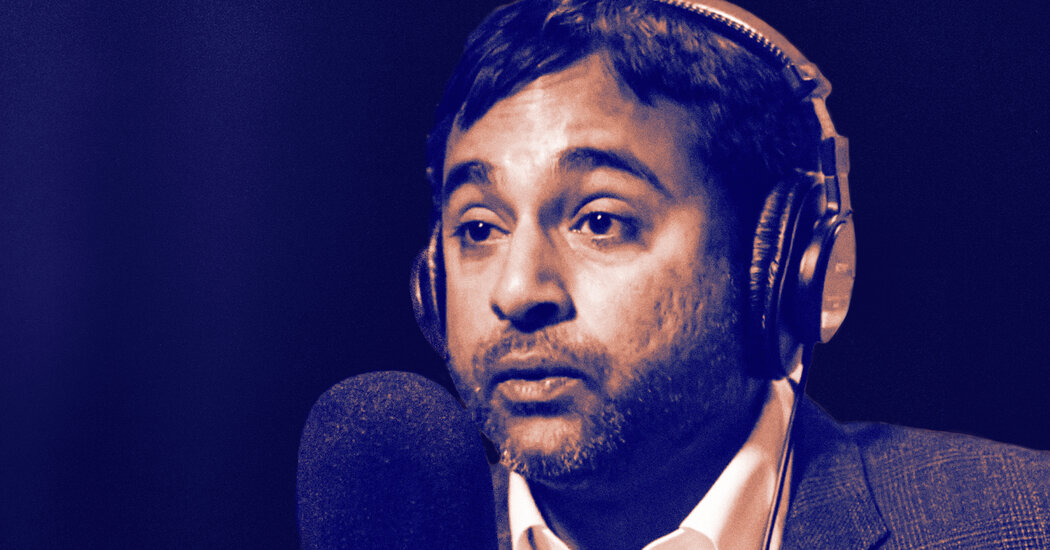
Democratic socialists are having a moment. But can they actually remake the Democratic Party — and the American economy — in their image? My guest today, Bhaskar Sunkara, is a longtime democratic socialist, and he makes the case that socialism has a universal appeal that transcends our current politics and will ultimately triumph against capitalism.Below is an edited transcript of an episode of “Interesting Times.” We recommend listening to it in its original form for the full effect. You can do so using the player above or on the NYTimes Audio for listenRoss Douthat: So it seems like the bright, glorious future of the Democratic Party might just be: socialism. But what does socialism stand for, comrade, in 2026? And does it offer America a path to the workers’ paradise or a political blueprint for radicalization and defeat?My guest this week is associated with one of the oldest and one of the newest institutions on the American left. He’s the president of The Nation magazine and the founding editor of the socialist journal Jacobin.Bhaskar Sunkara, welcome to Interesting Times.Bhaskar Sunkara: Thanks for having me, Ross.Douthat: Thanks for being here.I want to start with a scorecard or an assessment of how the left is doing. And by the left, I mean the real left, the old left, the socialist left.Because just in recent days, democratic socialist politicians have won Democratic Party primaries in Colorado, in New York, in Washington, D.C.’s mayoral race. A non-socialist, but I would say fellow traveling left-wing Senate candidate, is leading primary polling in Michigan.And the democratic socialist mayor of this very city, New York City, is clearly the most interesting new leader in the Democratic Party. He’s the guy capturing eyeballs and attention and trying to build a movement.Then at the same time, we’ve just watched the left kind of face plant, with Graham Platner’s candidacy in Maine.You’ve been involved in the quest to make socialism happen for decades as an editor, a writer, an activist, a publisher. You wear a lot of hats.How’s the project doing right now?Sunkara: Well, I’m going to zoom out, and unfortunately, if you ask a Marxist what the weather is outside, they’ll start talking about the Neolithic revolution.Douthat: That’s right. We’ve got to go back 375 years.Sunkara: I’ll go back just 160 or so years. The first modern left, if you think about it, was the abolitionist movement. It was the radical Republicans. It was the labor Republicans.If you look at that transformation in the U.S., our world today compared to our world then, it’s hard to say that the left hasn’t radically transformed societies across the capitalist world.We live in a society where half the federal budget is spent on social insurance programs. So in a certain sense, the left is sometimes so pessimistic about the outlook for the future and so rightly outraged about inequalities today, that we underestimate the scope and the extent to which the societies we live in today have been profoundly shaped by various iterations of the left.Douthat: So you’ve already won. Socialism has won, and we’re just sort of tidying things up.Sunkara: We are not living in the worst of all possible worlds. In my mind, I think the left, including in America, deserves a lot of credit for that.I joined the Democratic Socialists of America when I was 17 years old. I joined a very long time ago. At the time, the organization just had 5,000 people. Today, it has over 120,000 members.As you said, Zohran Mamdani, who isn’t even just a nominal member, but a grass-roots activist of the organization, is the mayor of New York City.By many accounts, it’s not been a disaster.Douthat: Early days.Sunkara: Still early days, still room for disasters. But I think he’s governing with a level of confidence, with a level of competence that has surprised some of his critics. So obviously this is an exciting time to be a leftist in the U.S.Douthat: Say a little bit more about that. I was alive 30 years ago. Nobody wanted to identify as a socialist in American politics — except for Bernie Sanders.I don’t want to overgeneralize. I personally knew people who identified as socialists.But in national American politics in the 1990s, in the aftermath of the Cold War, socialism seemed like a dead letter. Now, it seems like a potent faction inside the Democratic Party with the potential to transform the party.So tell me. Why socialism now?Sunkara: Well, as long as there is inequality in a society, as long as you have a class society that divides people into people who own and people who have to work for them, there is going to be some sort of egalitarian response to it.And you could then say that capitalism is the best of all possible worlds. There’s no better system. But I think even defenders of capitalism would say it is based on certain degrees of inequalities.Now, I think there has been something unique going on in the U.S., which is a discreditment of the various political establishments of left and right alike, or liberal and conservative alike, that have given rise to unruly populisms of left and right.You know, it’s given rise to Donald Trump. It’s also given rise to people who really want Medicare for All, but also are angry about just everything — rightly or wrongly — that the Democratic Party establishment represents.I think this moment really sparked with both Occupy —Douthat: Occupy Wall Street.Sunkara: Occupy Wall Street, in 2012, but —Douthat: It was a long time ago. It really was. You have to remind people. Go on. Sorry.Sunkara: Yeah. Actually, it was 2011.Douthat: Even further back.Sunkara: Even further back in time. And, of course, also it crystallized itself in an electoral form with the candidacies of Bernie Sanders.I think this sense of disgruntlement, this sense that the best days of the U.S. are behind us, that I’m not going to have a better life than my parents, this pessimism has manifested itself in different forms.Trumpism is one response, and this democratic socialism crystallized by figures like Bernie Sanders and Alexandria Ocasio-Cortez is part of it too.Douthat: You made an interesting distinction between general economic inequalities and this sort of rebellion against establishments and elites.How much of the new socialism do you see as a fundamentally economically grounded enterprise, as opposed to an enterprise driven by the internet making establishments transparent and thereby discrediting them, or driven by people’s unhappiness with life under digital conditions?How fundamentally Marxist is this moment? How much of it is about income, dollars and cents, as opposed to cultural factors?Sunkara: Programmatically, I think it’s overwhelmingly about these economic issues. If you look at a figure like Bernie, if you look at Zohran, he’s talking about the cost of housing, he’s talking about health care, he’s talking about all these other bread-and-butter demands.Where the actual anger and support comes from, I think, is more diffuse. There are a lot of people who feel fed up, who feel like they want a different sort of politics, a politics of hope. In some cases, their perception of where their lives are going are a little bit different than the reality of where their lives are going.But I think —Douthat: Say a little more about that.Sunkara: So when people look at, for example, income levels of certain people that are voting for candidates of the left, I think they could rightly point out that these people from a comparative standpoint are not necessarily the most oppressed.In many cases, they’re earning raises at higher than the level of inflation, but they still feel like they’re being squeezed.I would point to the cost of a few headline goods like housing. Beyond that, I would say that a lot of people have been drawn to ideas of the left for purely normative reasons.I did not come from a particularly affluent background or anything like that, but I was drawn to the ideas of the left when I was in high school, when I had a part-time job at a Key Food grocery store.But I was politicized not by my experience of being exploited —Douthat: Proletarianized.Sunkara: I was not that, because in fact, I was so ineffective at my job, I’m almost positive I was producing no surplus labor.But I was politicized in the library books, reading books by people like Irving Howe, by Michael Harrington.Douthat: And Harrington, just for those who don’t know, was a key socialist intellectual of the midcentury ’50s and ’60s America, not a Communist vanguard trying to bring about violent revolution.Sunkara: He was part of the organic establishment, to the left of social democracy, people who just wanted to make capitalism a little bit more humane — but also, you could say, to the right of a certain Leninism.Douthat: Stalin. To the right of Joseph Stalin.Sunkara: Of course, as we should all aspire to be. The gap between what I thought society could be, given its abundant riches, and what it was is what politicized me.I think there is a layer of people who both feel economic security day-to-day or feel frustrations, but are primarily driven by these sorts of normative egalitarian philosophical ideas.I don’t see a huge contradiction there. I just think we should be aware of the fact that we still don’t have the deep level of rootedness that other redistributionist movements in the past have had — like, say, the New Deal coalition in the U.S. from the ’30s to the ’70s.As long as we’re aware that our goal is to get deeper roots fundamentally in all layers of the working class, then I think we’re moving in the right direction.Douthat: So what do socialists want then, in practice? You’ve referenced housing and Medicare for All and so on, but if there were a socialist contract with America, God help you, what would it say?What would be the five points, and how would those be different from what Amy Klobuchar or a conventional Democratic politician would be inclined to support?Sunkara: Well, for one thing — and I mean this earnestly — as far as I can tell, American socialists are way more liberal than they themselves think, in that they truly do believe in pluralism and multiparty democracy and in certain places the state should not go. There’s been a sort of reconciliation of liberalism and socialism.Douthat: So you’re saying that if there’s a socialist contract with America, it does not promise collectivization and a one-party state?Sunkara: I think we believe in a Bill of Rights socialism.Douthat: So what is it?Sunkara: There’s an immediate set of demands that you could call us attempting to bring about doses of socialism within capitalism.This comes in the realm of decommodification of certain goods, providing them as social rights instead of them being dependent on your ability to pay.Health care in America is partially decommodified. If you’re elderly, if you’re very poor, if you’re a child, you’re going to have guaranteed access to health care. We want to see that extended.Same thing with things like Social Security and certain other benefits, or an expansion of the welfare state — not unlike Norway.I also would go further and say that even within capitalism in the here and now, there are sectors of the economy that I would like to see greater state control of. In the old language of the left, we would call it the commanding heights of the economy, but even things like rail — there are benefits to selective nationalization, particularly of natural monopolies.That vision right there of socialism within capitalism, could be true of a lot of social democrats.So beyond that, the question is: Why would you go about calling yourself a democratic socialist? For me, I call myself a democratic socialist because I actually believe in a socialism beyond capitalism.I actually do believe in an economy built on the idea that workers should control their workplaces and on this more radical vision of a society without capitalism, even if it still has a motor needed for investment and for efficiency gains and growth and so on.Douthat: That vision is not going to be the vision of the National Democratic Party in 2028, presumably.But there is going to be a vision of the National Democratic Party in 2028, and if the faction that we’re talking about here — and I think we can say it includes everyone from people who envision a world beyond capitalism to people who are just sort of fellow travelers who want the Democratic Party to move to the left — if that group wins, then the party becomes definitively pro-Medicare for All, definitively pro various other expansions of the welfare state. What else?Sunkara: I think that’s a great immediate program to win over people. If you can’t convince people to have an American National Health Service or a single-payer system like they have in other industrial countries, there’s no way you’re going to convince a majority of people that every cook can govern and everyone should own their workplaces.I think that would be a great and good enough place to start. You have to listen to people and listen to what their demands are.I’ll give you one quick example. Dan Osborn is running as an independent in Nebraska for Senate, and one of his key demands is the right to repair. The idea that if you have your John Deere tractor, you should be able to open that tractor up and do basic maintenance without voiding your warranty and not having to send it to some special service center.There’s no socialist in America who’s against that demand. That’s also not a demand that would naturally come to us, living where we’re living in Queens and Brooklyn.I don’t have a patch of grass in front of my apartment, much less room for a riding mower.But that comes out of being in a certain environment, talking to people, hearing their concerns, and I think a lot of the program of any party, the Democratic Party or the Republican Party, needs to come from dialogue with constituents and people you want to win over.Douthat: OK. But those people in Queens who you mentioned, they’re concerned about housing, right? Is the leftward view of what housing policy should be for the Democrats, going forward?Sunkara: I think everyone can see, across the political spectrum, that there’s a huge problem with housing construction in the U.S.So Zohran’s policy, for example, in New York, is very heavily built around upzoning and making it easier for developers to build, and I think people agree with that.But beyond that, I think on the left, we point to successful examples around the world of public housing being done right. We think at least part of the construction needs to be public housing. We also need to maintain and expand existing units.I think that’s the room for the state to step up and do more things. But I think these solutions are largely, first and foremost, on the supply side. Then beyond that, we do believe in certain stabilizations and other things.Douthat: Rent stabilization, meaning rent control or —Sunkara: Rent control, which can be designed well. It could also be designed poorly.But you could imagine, for example, telling landlords: “We’re going to clear the way. We’re going to allow you to create this big housing development. We’re going to fight against the interests of local homeowners, and you build your big piece of housing. But after 30 years, after you have a reasonable return on investment, that unit is going to have some degree of rent stabilization,” for instance.That, to me, is a perfectly common sense, economically coherent vision for housing. I know there’s lots of talk on the left and in the Democratic Party about the debate over abundance, but fundamentally, any form of social democracy is grow-give.There needs to be a motor for economic investment. There needs to be profitability in order to have something to redistribute. The added component that I would say is an important part of a socialist agenda is making sure that there are strong unions in workplaces that can advocate for higher wages even before the state gets involved with redistribution.Douthat: What about A.I.? Bernie has taken some pretty strong stances, I would say. He has sort of staked out a position as the Democratic politician most open to both doomer narratives about A.I., but also most enthused about the prospect of strong government intervention.What is the socialist position on the A.I. industry right now?Sunkara: I think there’s a host of different socialist positions. I lean more on the side of just seeing it as any other technology. Companies are going to invest in new technologies. The economy is going to change. We’re going to need to adapt and figure out how to regulate it.Obviously, any changes that we do, any regulation we need to do, need to make sense in an international context too.It doesn’t make sense to tank certain U.S. companies if there’s going to be other companies creating the same disruption that are coming from other parts of the world.But I think this gets to the level of policy where there’s legitimate debates. I think the idea which has been touted by figures as varied as Bernie Sanders and Steve Bannon is of the U.S. government owning a stake in major A.I. companies.It makes perfect sense, too. But, fundamentally, we have to respond to a dynamic economy in which there’s always going to be new technologies, there’s always going to be new wants and needs, and new goods and services, and we need regulation that’s able to be flexible and adapt with changes.Douthat: But you don’t see A.I. as, let’s say, a once-in-a-century opportunity for socialism? In the sense where, you’ve just described a pretty expensive list of things that socialists want to do, right? So I feel like there’s an imaginable future where socialism gets invested in the idea that there’s going to be this A.I. surplus that can then be redistributed to create the social democracy or the socialist democracy of our dreams.What do you think about that conceit?Sunkara: I do think there’s going to be productivity gains. I think our goal has to be to make sure that companies that are seeing increases in profit because of these gains are forced to invest in expanding production and invest in the economy and not just cut bigger checks and bigger dividends to shareholders that obviously still have some sort of economic effect, but is way more diffuse than those companies just expanding production.Douthat: Let’s just say we’re talking about OpenAI or Anthropic or something, right? And suddenly they’re making insane profits. Lots of new billionaires and so on, and you’re Bernie Sanders or you’re a socialist president in the future who’s not Bernie Sanders.What does it mean for them to invest in the economy, first of all?Sunkara: Well, I’m fairly confident, I could be wrong, that OpenAI and Anthropic will never be making huge amounts of profit. But I think their technology will enable other companies to make huge amounts of profits.What we want on the left is not just to increase your corporate tax, but we also want you to make sure that you are finding other avenues in the economy to take that surplus from and to invest in more jobs and meet more needs.My only fear with the direction of the economy here is that more and more companies are just going to cut checks to shareholders, and we’re not going to have the massive growth we had in the midcentury from new technologies.Douthat: What is the political policy mechanism that gets that company to invest in six new factories in Wisconsin instead of doing shareholder capitalism?Sunkara: One mechanism is actually stronger unions. I know this sounds counterintuitive, but stronger unions and forms of sectoral and centralized bargaining.So basically saying to companies, “Across the board, your competitors have to deal with the same wage floor too. Now you have to deal with demands of paying auto workers an extra five, 10, 15 dollars an hour.”What that will do in reality is it’ll take the weakest companies in the field, it’ll probably make them collapse. It would allow the companies in the middle of the field to survive and continue to find ways to innovate the level of labor techniques and labor-saving technology, and it would enable the companies at the top of the sectors, the benchmarks producers, to be able to have some excess profits that they could then invest to maintain their market share.That’s just a classic example for social democracy of something that seems like it would tank the economy — stronger unions — actually being used to push the economy toward more productivity and more technology.Douthat: You’re using unions to create, in effect, stronger market pressures.Sunkara: Exactly. It’s still, I think, part of the logic behind even crude measures like the minimum wage — let’s not just sweat out labor, let’s figure out a way to make companies more productive.I think those are all sorts of mechanisms, I’m just using those as examples, that aren’t just regulatory. It isn’t just ex-post redistribution, though. I’m also for smart common sense regulations and of course, I’m obviously for redistribution. Socialism needs a tax base for a welfare state.Douthat: But just pulling back, I feel like we’ve danced around this a little bit, so let me just ask it directly: Is democratic socialism compatible with capitalism?Sunkara: In the long term, no. We’re anticapitalist. We want a world beyond capitalism. But in the short term, while we’re within a capitalist economy, of course, we need firms that are profitable, that are providing employment, that are providing taxation. So I think to govern in the short term as social democrats, we need profitable firms.But in the long term, you know, I don’t hide my desire that I think the economy should be socialized, even if I think in the socialized economy, there needs to be a role for markets and also a role for worker-controlled firms to be able to meet people’s needs and provide new goods and services.Douthat: What’s the distinction you make between capitalism and markets then?Sunkara: Well, I think markets existed before capitalism. Capitalism is a regime of property ownership that says that as an individual capitalist or as a corporation, we own this private property and we use this private property to employ people and to produce goods and services.And in my vision of a just society, of a socialist society, that private property would be controlled by ordinary workers who would get their financing from public banks, who would still operate with hard budgets. They would still need to meet goods and services and meet their payroll obligations and things like that.But you don’t have a class of people who, as individuals, control investment decisions.Douthat: I want to pivot now for a minute and talk about how socialism relates to other visions on the left, that have had a lot of influence in the last five years, like what gets described as antiracism, identity politics or wokeness by its critics.Because it seems like to me, as an outsider, on the one hand, you get socialism sometimes offered as this alternative to identity politics, where you say: We need to just be focused on class and money. That’s what we need to do.But then at the same time, actual socialists, actual socialist politicians tend to have very progressive views on social and cultural issues, right?So tell me how is the socialism that is having a moment now — and had a moment with Bernie — related to progressive cultural politics?Sunkara: Well, I’ve been identified as being a member of the anti-identitarian left, but I myself do believe that if people are facing oppression, if they’re facing some type of discrimination, then of course they shouldn’t be discriminated against, and they have the right to organize as their own groups and press and lobby for change and redress. And I’ll be fighting alongside them.I just am fundamentally not so pessimistic about the United States at a social and cultural level. There have been plenty of studies, including one by the Center for Working Class Politics, that makes the argument that U.S. workers are indeed moving leftward on cultural and social issues. They’re just moving leftward at a less rapid pace than professionals.So to me, if you have a group of people who say: “You know what? I think that it’s a complicated issue, but I believe in a woman’s right to choose.” And then you tell them: “Well, what about late-term abortions? What about this? What about that?” It’s almost like the left is trying to, through this Overton window theory of politics, to just … They’re taking a yes, and they’re demanding a much harder position than they deserve.Same thing obviously with immigration and a host of issues. My parents came to this country for a reason the year before I was born. The United States has been an incredibly welcoming home. I still think it’s the best — or one of the best — places for immigrants on the planet.Douthat: So to some extent, it does sound like you think that the left took a wrong turn in the peak woke early 2020s culture war, and maybe the wrong turn was partially just talking about America like it was the most racist country in the history of the world.Basically, was there a turn that the left took in that period that socialism can help correct?Sunkara: Well, I actually blame the center and the center-left for a lot of these things, and I think that it was the Hillary Clinton campaign in 2016 that tried to draw these extreme contrasts.I remember Bernie Sanders was killed because he had an ad with a Simon and Garfunkel song on it, “America,” because he ran this ad right before the caucus in Iowa and the primary in New Hampshire, and they said, “There’s too many white people and it’s too rural. Is this your vision of America, socialist?”I think a lot of this came from those directions. I also think that —Douthat: Just so people are aware of this, this is a really interesting part of what happened in Democratic politics. The Hillary Clinton campaign, which was the more centrist campaign, or perceived that way, really did sort of try and use identity politics issues against Sanders.It’s true that the center sort of tried to weaponize identity politics against the left, but the left didn’t necessarily resist, did it?Sunkara: I think by the time he ran in 2020, Bernie did try to frame more things … he kept his old universal demands, but he would often explain why they were good in terms of closing disparities.Medicare for All is antiracist because disproportionately it’s going to help uninsured people who are Black and brown. At a certain level, obviously, that’s right, but it seems like a weird way to pitch a universal program — talking about disparity.But I would push back on just one thing you said, which is: America was the most racist country in the history of the world, and I think the left actually does a great discredit to its own history when it pretends like it still is. Because we’re a country that fought a revolution — led by the left, in my opinion — that abolished slavery by force of arms, not slow and gradual emancipation.We fought against Jim Crow, and we also got rid of that with socialists largely at the helm or at least playing major roles. And then we got to the point where we elected a Black president, and that Black president won even the state of Indiana in 2008.It just seems so strange that it was in part the election of Donald Trump against Hillary Clinton that convinced so many Americans, so many liberals particularly, but even some leftists, that America was irredeemably racist when those same voters had just voted for a Black president twice.So, in a way, I think I want to recover some of the optimism about the U.S. we felt during the Obama years. Also, for what it’s worth, my parents still feel about the U.S. what so many Latino and other immigrants feel about the U.S., which is they came here for a reason. This is a good place. This is a good country filled with, by and large, good people.Douthat: Yeah. So it’s a story where it is maybe as critical of the American past as peak woke was, but has a much more heroic narrative about what’s happened since. Is that, that fair to say?Sunkara: Absolutely.Douthat: How much room in that narrative is there for actual cultural moderation? Like, is there a world where you can be a socialist or socialist-friendly politician and not be in favor of abolishing ICE, or not be in favor of transgender girls in girls’ locker rooms? You could pick whatever issue you want.But, is there a world where socialists can get away from cultural litmus tests or not?Sunkara: Well, first of all, it has to be on an issue that you actually believe in. So on immigration, I am actually a very orthodox leftist and I want to abolish ICE.Obviously, we still need some sort of border enforcement and customs, but at least go back to the norm before ICE. This is that radical demand, but that’s a demand I’ll make.But then I look at a figure who’s not a socialist, but a left populist like Dan Osborn, and he’ll talk to an audience with Trump voters, and he’ll have two lines, and the first will make every socialist in America gasp when he’ll say: “I agree with Donald Trump. We need a strong border.”But then his second line will be: “But I can’t tolerate what ICE is doing, separating mothers from their children. This is a problem.” And everyone in the room will clap and applaud.And I ask you, what is more progressive: Me saying what I say about ICE, and what I truly believe about ICE in New York City, or Dan Osborn saying those two sentences in Nebraska?I think that on a host of these issues, as we have candidates that are running viable campaigns, as they’re running in different districts, including in semi-rural and rural districts where liberalism and Democrats themselves are totally wiped out as a brand, I imagine socialists will adopt different rhetoric on different things.They obviously have to adopt rhetoric that they believe in, because authenticity is a big part of our brand. People, when they talk to Zohran Mamdani, a common response when we were canvassing was something like, “You know, he says what he means, even if I disagree with him.”Obviously Trump has some of that factor too, and I think authenticity is the opposite of focus group politics. We have to balance the two.Douthat: Yeah. I think that makes sense. I also think so far, the pattern I’ve seen is that there are a lot of people in the Democratic Party who say, “We can move to the left on economics as a way to avoid talking about cultural issues.”The trans sports issue is a good example. You heard this from Platner before his flameout. He would say: People who want to talk about this issue just want to distract you from inequality and class.And that can be an effective argument, but it still leaves the voter who doesn’t agree with your party on the issue feeling like they’re not being heard, right?Sunkara: Well, I think to moderate, we also need to articulate a vision of a good life that’s compelling. My vision of a good life is, I think, quite similar to a lot of ordinary Americans: I want basic security for a family. I want to raise a family.And when we talk about, let’s say, why we support gay marriage and full civil liberties for L.G.B.T. people, it’s about giving them this opportunity to live normal lives. Not forcing them into the margins of society.What it means to be normal is to articulate commonly held beliefs that I think most socialists do.Douthat: To take your Osborn example, though. It’s one thing to be a Democrat and say, “I believe in a secure border” because that’s a generality. It’s harder to be a Democrat and say, “Because I want to win Nebraska or Oklahoma or whatever state, I’m going to say I support Trump’s border wall.”I feel like there’s a desire to just not get that concrete in your moderation. That’s all.Gaza. It seems like one unusual thing about this socialist moment is that it has a foreign policy issue at the center of a lot of its energy.Is that fair? And if so, how does that fit together with a push for redistribution in the United States, if people are drawn to Democratic socialism because it seems like the most anti-Israel, pro-Palestinian perspective?Sunkara: The immediate forerunner to the Democratic Socialists of America, the Democratic Socialists Organizing Committee — we’re not very original in how we name these organizations.Douthat: It can be confusing sometimes.Sunkara: It was founded in the early 1970s, and had a very different view on Israel and Palestine. It was pro-peace, two-state, but it was in an era when there was relative parity between the strength of the Arab states and Israel. If anything, before the Six-Day War and the Yom Kippur War, it actually seemed like the Arab states with all the Soviet support were actually stronger.There were very recent memories of the mass exodus of Jews from the Arab world itself into Israel, and of course, more recent memories of the Holocaust and so on.Also, there was a center-left and a left in Israel, and also in the Palestine Liberation Organization that we, as democratic socialists, could relate to. I think that led to a certain balance, rightly or wrongly, in how that conflict was interpreted — with lots of complications.I think what’s really changed is the parity is gone. Israel is a dominant power. It could inflict violence at any turn.Internally, Israel has become quite right-wing, and driven by deeper and more violent forms of religious nationalism. And also, tens of thousands of people have just been killed in Gaza. I don’t think there’s a broader philosophical shift so much as the environment has changed quite a bit.Douthat: I don’t think any of that is surprising. I just think it’s an interesting question for socialists if this particular issue ends up being central to the movement.Let’s say I was starting a movement of religious conservatives, and we said: “We’re here to revolutionize the United States of America, revolutionize family life. We’re going to put the Ten Commandments back in here. We’re going to bring back blue laws,” — you could make some long list.And then it turned out that lots of young people were joining our movement, but they were mostly there because they were concerned about China and Taiwan, and we had a pro-Taiwanese position. That would be kind of weird, wouldn’t it?Like, it would raise some questions about what is the reality of the movement? Is this really a movement for redistribution, or is this a vehicle for changing the Democratic Party’s position on Israel? That’s what I’m asking.Sunkara: Well, speaking of your conservative platform, by the way, I am in favor of Utah-style liquor laws, so there’s a host of issues where I’m maybe right of center —Douthat: I think it’s clear that we can find some common ground.Sunkara: I think on this issue, the key difference is the U.S. socialist movement has always had anti-imperialism and anti-militarism as a core part of its platform. It’s one reason why we were marginalized during the First World War when we dealt with the first Red Scare. We were one of the few parties — the Socialist Party — in the U.S. opposed to entry into the war in such extreme forms that we even launched an abortive armed rebellion in the state of Oklahoma to protest against U.S. entry into the war and conscription.It’s been a long part of our history, and socialists throughout have opposed things during the Cold War, opposed the Vietnam War, opposed the dirty war in Central America in the ’80s, opposed support for groups like the Argentine junta.So in my mind, Israel flows out of that, and when I think about causes that I care about in the world, Palestinian self-determination is there with self-determination with Western Sahara.Douthat: Western Sahara does get slightly less attention, I’ve noticed.Sunkara: I think in part it’s because of the scale, but also because of how directly the U.S. is involved. If the U.S. was sending more arms to Turkey that was being used in the occupation of their statelet in Northern Cyprus, then I would be talking about that as well.I actually talk probably more about Cuba than I do about Israel-Palestine because I’m a socialist concerned about the blockade. That’s been a very traditional part of socialist thought.But I do think the difference is anti-imperialism, antimilitarism has always been a part of the socialist movement at a programmatic level.I would say among young people, Israel-Palestine has been a symbol, and it has become this, in not just the hard left, but across Gen Z and millennials — including people who otherwise are not super politicized or down with the rest of the socialist program. It has become this popular issue.But because of our credibility talking about U.S. involvement in the region and U.S. involvement in the world and many different other facets, I think it has benefited the left. But I don’t think it’s as unusual as you think.Douthat: I didn’t mean to suggest that it was necessarily completely unusual, and I certainly agree that there’s a profound continuity between left-wing views on foreign policy going back generations and what you see right now.It’s more that we’ve been talking in this conversation about whether socialism can become a concrete policy agenda. And when socialists opposed U.S. involvement in Central America, that mobilized a lot of energy in the 1980s, but it didn’t have any effect on debates about the welfare state, right?And the Vietnam War led to the crack-up of the Democratic coalition. It’s more that I’m sort of curious if you can take the energy that you’ve mobilized around Gaza and use it to pass Medicare for All.Sunkara: I don’t think it’s completely cynical, but I think it’s being used to separate Democrats who are committed to an old political establishment, including the foreign policy establishment, and Democrats who are better.So D.S.A members love Brad Lander in New York City. Brad Lander talked a lot about Israel-Palestine, in part because it’s this battle beyond the moral stakes of what’s at issue in Gaza, it’s a battle within the Jewish community that’s in part a generational battle that he’s been a part of.But also, I think all of us are very skeptical of Goldman’s commitment to things like Medicare for All and how he would vote on a proposal in the Congress.Douthat: Dan Goldman is the congressman who just lost to Brad Lander in the primary.Sunkara: So, I think, in that case, the two go hand in hand. It would be a more complicated situation and harder to imagine if there was less of a direct correlation between stances on progressive economic issues and stances on Israel.Douthat: I see what you’re saying. In practice, if you get someone who is pro-Palestine in this particular way, you are more likely to think of them as a reliable vote for restructuring the Democratic Party overall.Sunkara: Yeah. Absolutely.Douthat: OK. All right. Let’s do two extremely skeptical questions to end with, in case I haven’t been skeptical enough, about two reasons why this sort of socialist moment might be stillborn. The first has to do with its political consequences for the Democrats winning elections before you get to governing. Winning elections in 2026 and 2028, right?You talked earlier about the idea that socialists in the United States have made their peace with liberalism. They’re not enthusiasts for whatever Mao wanted to do or anything like that. We see socialism as operating under the tent of certain liberal norms.I don’t know if I think that that is completely true. I don’t think it’s really true of the personnel who are most involved in the D.S.A. I think that if you look at data on people who are deeply involved and occupying important offices in the D.S.A. itself, you do have a lot of people who I would describe as Communists, not merely as socialists, who are quite radical.I think you also have, in online culture on the left, a certain kind of illiberalism that is favorable to someone like Luigi Mangione. It likes to flirt and play around with violence.So my question is, one: Isn’t that a problem, period? Like a moral problem, I guess you could say, for a socialism that wants to be part of mainstream America in the way you’ve described?And second: Isn’t it a political problem if the association of socialism taking over the Democratic Party is with people who are sort of Luigi Mangione-curious?Sunkara: Well, to begin with, I think in youth culture as a whole, there was this obsession with Luigi Mangione that I found deeply disturbing, and I think it’s very fair to say that’s illiberal. That’s also the creation of a horrible environment for anyone to do politics of any type or even just to live in a civil society.I think, as Americans, we’ve been lucky enough to live in a period where we could have disagreements without mass violence. But between Luigi Mangione, between the assassination attempts on Donald Trump, between the killing of Democratic state legislators, you’ve seen little baby steps in the wrong direction that we should condemn — though I think that was more of a diffuse populist sentiment.I would say there are people who self-describe as Communists in the D.S.A., but what this handful of people are doing are invoking a tradition that in other contexts we would just call anarchism.My tradition on the American left is very aware of Stalinism, of authoritarianism, of its threat. I don’t think those currents exist in even the smallest margin in D.S.A. I think you have a lot of youthful, ultra-leftist people who like the word because it’s more transgressive. But nobody is looking to the Soviet Union or anything like that.I think it is useful to see that as the evolution and the liberalization, in a good way, of the American left over the years and through the experience of the collapse of the Soviet Union.Douthat: Aren’t there people, though, who would say that if it wasn’t for the U.S. being so vicious and imperialist that Cuba and Venezuela could be models? I feel like you’d get that.Sunkara: Definitely. You would get that in a minority. For what it’s worth, my view on Cuba is that if not for the U.S. blockade, Cuba would have liberalized in quite a —They wanted to pursue Sino-Vietnamese reforms. They would have liberalized in a lot of different ways.But yeah, you definitely see that in portions. And also, it’s an organization, at this point, that has around 121,000 members. So I’m sure you could find divergent views.Douthat: But it becomes a political problem insofar as then it manifests in the positions that have been staked out by candidates. So even if you don’t get a lot of House candidates who have endorsed the Stalinist purges — I don’t think you will get that — you will get lots of them who’ve endorsed things like police abolition, things that were briefly popular in 2020 and are not very popular right now.Sunkara: These ideas came from the groups, though. It came from liberal N.G.O.s that might have had a lot of left-wing influence, but came from parts of the Democratic Party that were quite mainstream. And —Douthat: I completely agree with that.Sunkara: So I think it’s a problem across the left.But in practice, Zohran Mamdani right now is administrating a Police Department with over 30,000 armed men and women, and he’s administrating it, by many accounts, well.I think in practice, the experience of governance, of competing in elections is a moderating force on a lot of these issues.In my mind, the biggest danger for D.S.A. is actually that it transforms itself over time through excessive moderation into something like the new version of the Congressional Progressive Caucus or what the Black Caucus was in the 1980s. That it eventually becomes more social democratic and less interested, like I am, in the old questions of power and redistribution and the means of production.Douthat: Let’s end with power and redistribution then, and practicality.So you’re saying the proof of the nonradical effectiveness of socialism could be in Mamdani’s governance of New York City. It could also be in the governance of the United States of America by a Democratic candidate for president who won an election and wanted to govern, not maybe as an avowed socialist, but in line with some of these ideas.We just went through an experiment in the Biden presidency where Joe Biden came in, he had people around him who were not as far left as Jacobin, but were further left than people around Barack Obama had been. They were influenced, I think, by some of the economic ideas that you referenced earlier and kind of had a belief that there were a bunch of things that you could do in short order to spend money, create new programs, that these would be very popular, that these would yield more growth, and that these would be the foundation for a durable majority.That didn’t happen. In practice, the new spending yielded inflation and backlash. What prevents that from happening again? To put a finer point on it, the new socialism enters into a political landscape where Medicare for All may poll well, but taxes are still very unpopular. Lots of Democrats are running away from the idea of taxing the upper middle class. How do you actually govern in this environment in anything but a defensive way?Sunkara: Well, I hate to defend Biden. I do disagree with the assessment, in terms of the Biden administration was a time when we recovered an economic level from Covid in a way that created hundreds of thousands of new manufacturing jobs at a time that across the rest of the capitalist world were shedding manufacturing jobs.Compare the manufacturing job loss in Germany. Obviously, they had less job loss in the ’90s, but compare that to the fruits of Biden’s industrial policy, which obviously doesn’t happen without Trump bringing up the specter of industrial policy and tariffs in 2016.But Biden, I think, did it right. I think his failures were fundamentally the failure to communicate to the American people, and we don’t need to get into that aspect of the Biden administration. Also, I do think —Douthat: Well, but no. It’s relevant, right? In that sense, this is where someone like Mamdani is relevant. If the left thinks that its core problem under Biden was just salesmanship, Mamdani is clearly an example of someone who can do salesmanship in a way that an aging, decrepit Joe Biden couldn’t. So is that the theory?Sunkara: I would say that’s at least part of it.I’m just defending some of the economic record. I think there was a lot rotten elsewhere in the administration. But also when it comes to Jacobin being to the left of the Biden administration, the people around it — yeah, of course, programmatically, we’re way to the left of the Biden administration.But to your wider question, of course, there’s going to be difficulties that emerge in administration and, of course, the welfare state in particular, as it’s constructed now, will be harder and harder to sustain with its current dependency ratio with aging populations.And of course, the left will often get into power and administer poorly or have a run of bad luck and lose elections. I think that’s why we need to combine this desire to find the right sort of immediate social democratic governance that works with the longer-term egalitarian vision of creating a society with less hierarchy, with less division between people.My vision of a good society might take centuries to enact, and I’m perfectly comfortable to sit by and wait in my hyperbolic chamber.Douthat: That was a great peroration on which to end, but just in the practical, in the here and now, isn’t the problem just you have to figure out how to raise people’s taxes?Sunkara: I think that any welfare state will require greater degrees of taxes that won’t just come from taxing billionaires. There’s not enough money there. We need to convince people that if we are raising taxes, they’re going to get a larger social wage back than they’re giving up in taxes.So yes, taxes will have to go up on middle-class people, but also at the same time, we need to look for efficiency in the existing American welfare state, which is an expensive welfare state.Douthat: Just so we agree, there is a functioning socialism as a governing ideology in America that needs to win an argument about taxes that the left has lost for a while.Sunkara: Sure. I think everything in life involves trade-offs. I can choose to have two drinks tonight, or I could choose to —Douthat: Depends how you feel this podcast went.Sunkara: Everything in life requires trade-offs. Everything in government, in an economy requires a trade-off.Obviously, the economy itself is not zero-sum, but money has to come from somewhere. There needs to be more taxation on, I would say, professional class people over a certain income threshold.I think we can win that argument. We should start with something like Medicare for All, where I think there are significant efficiency gains to be found from having a single payer too, which will offset some of the extra expenses.And I think there’s a host of other issues where simplification of the welfare state by making things universal will yield some of the savings, but not all of it.Douthat: OK. Good. I’m sorry to end on practicalities rather than eloquence, but Bhaskar Sunkara, thank you for joining me.Sunkara: Thanks for having me.Thoughts? Email us at interestingtimes@nytimes.com.This episode of “Interesting Times” was produced by Sophia Alvarez Boyd, Victoria Chamberlin, Raina Raskin and Rochelle Widdowson. It was edited by Jordana Hochman. Mixing and engineering by Isaac Jones and Pat McCusker. Cinematography by Kyle Kelley. Video editing by Brandon Belk-Yee, Arpita Aneja and Julian Hackney. The supervising editor is Jan Kobal. The postproduction manager is Mike Puretz. Original music by Isaac Jones and Pat McCusker. Fact-checking by Mary Marge Locker, Julie Beer and Michelle Harris. Audience strategy by Shannon Busta, Kristin Lin and Andrea Betanzos. The executive producer is Jordana Hochman. The director of Opinion Video is Jonah M. Kessel. The deputy director of Opinion Shows is Alison Bruzek. The director of Opinion Shows is Annie-Rose Strasser. The head of Opinion is Kathleen Kingsbury.The Times is committed to publishing a diversity of letters to the editor. We’d like to hear what you think about this or any of our articles. Here are some tips. And here’s our email: letters@nytimes.com.Follow the New York Times Opinion section on Facebook, Instagram, TikTok, Bluesky, WhatsApp and Threads.
Diterbitkan : 2026-07-16 09:04:00
sumber : www.nytimes.com