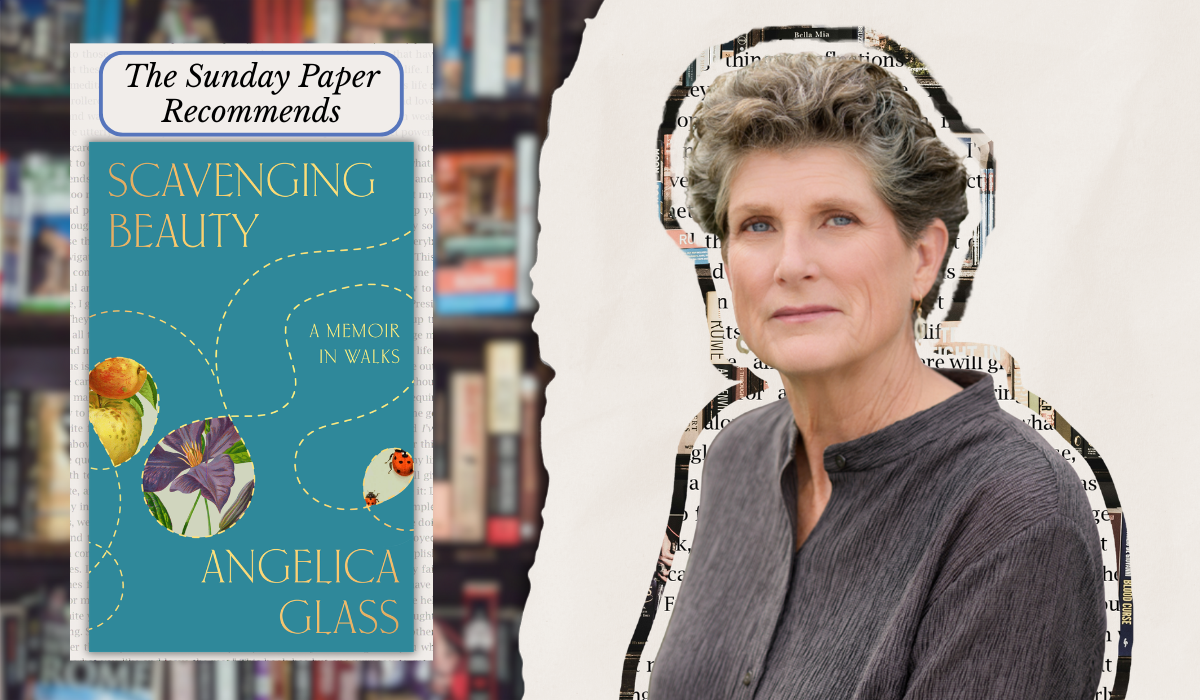
An Excerpt from “Scavenging Beauty: A Memoir in Walks” by Angelica Glass
I have a vague recollection of noticing my shadow as a child or, more specifically, noticing that it was sometimes with me and sometimes not. Its presence seemed random, mysterious. If someone had explained that it was the sun that was pulling the strings, I might have filed it away as an interesting fact, but it would not have settled into me as it has learning through rapt observation. Objects in the path of light displace the light, causing shadows. Objects submerged in liquid displace the liquid, causing overspill.I’m thinking about how these relate to my immersion in nature and beauty, and the ways these days of wandering, discovering, noticing, remembering, and expressing are fundamentally changing me. It’s true: These infusions of natural beauty are displacing, maybe even replacing, my years of self‑doubt and self‑ridicule. I’ve seen dead skunks, baby coyotes, bobcats, rabbits, foxes, and frogs on my walks along the roadsides and trails all over the county. My first reaction is always to look away, but the lure of the lens draws me closer to study the shape of claws, talons, and scales, the details you don’t get to see when you’re observing live animals from a respectful distance.In Felton, north of Santa Cruz, on a long, steep walk I stop to sit along the roadside for a quick snack. When I get up to leave, I discover several feet away a nearly complete coyote skeleton with moss growing between the joints. I recoil, a split‑second jolt of adrenaline stunning my bloodstream. But I settle my breath and employ my cherished lens to help me bore deeper into the simple beauty of the knobby epiphyses of the long bones, the porous insides (that admittedly always remind me of seafoam, an airy, crunchy, toffee‑like confection), the spinal xylophone, and the birdcage of rib bones.Before the walks, I hadn’t understood how after moving past the reflexive wince one can appreciate the staggering beauty of the vessels we animals occupy. There’s much to be gained by not looking away, and as the miles pass below my feet, the same comes to apply to looking back on my early years.My stride slows when I spot a freshly eviscerated doe in the middle of the road. I scan my surroundings, half expecting to see a mountain lion and wanting to avoid getting between it and its kill. Instead, I see two sets of eyes: coyotes standing in the scrub just twenty feet away. I give them and their bloody breakfast a wide berth, but I turn back and take a few photographs of the wild canines with telltale blood‑stained fur around their mouths, and of the deer’s gaping chest cavity with all that was once tucked neatly inside now strewn on asphalt. I wait to feel repelled, but I don’t. I zoom in, looking closer at exposed ribs, matted fur, and that carmine elixir, spilled in pools. I think gazing so frankly upon gaping wounds in the natural world has made it possible for me to more fully acknowledge and face my own emotional carnage.I tried to have some semblance of a relationship with my mother right up until she died. From the time she left our family home when I was thirteen, until our last phone call when she told me that she intended to end her life, I was the one to initiate any interaction we had. Every few years I suggested that we get together. I tried to include her in major life events, graduations and weddings. She occasionally came. I understood that it was hard for her to trust people and that her relationships with her kids were all strained. For thirty‑seven years, I wedged my foot between an invisible door and its jamb so she couldn’t slam it shut. I wanted to leave a shaft of light between us in case she woke up in a darkened room regretful and lonely.I talked to her when I first started falling in love with Ellen. I called her to share my joy when Ellen was pregnant with Miles.“Why in the world would you do that?” she demanded, incredulous. “Kita’s a teenager. You were almost free!”It was a stabbing reminder of her conception of freedom—and motherhood.I called her again when he was born to let her know that she had a new grandchild.Finally, seven years into my relationship, I told her that I wanted her to meet Ellen and Miles, who was six years old at the time. We visited her in her mobile home, where she answered the door and said, “You must be Helen (to Ellen) and I guess you’re Eric (to Miles).” I clarified their names and laughed it off.The next time I saw her was four years later, when she reluctantly agreed to come to our wedding, but not before warning me that if any of my siblings gave her a sliver of grief, she would “clobber” them. It was an empty threat. No grief was given. My mother only acknowledged the presence of those of her children who approached her directly, but no punches were thrown.I thought I had forgiven my mother. But walking mile after mile, primarily in solitude, thinking about my life, everything is up for review. The farther I wander, the more nuanced becomes my understanding of forgiveness and the balder my self‑honesty. I know what it is to authentically forgive someone; I’ve been on both sides of the equation. To continue to classify my forgiveness of Barbara as authentic was to bastardize the very concept.I had neither forgiven nor not forgiven her, neither blamed nor excused her. I realized as my feet steered me along that I had simply exploited the idea of forgiveness, crouching in its shadows, stockpiling silent rage to avoid the work of reconciling my heart. I had crowned myself emotionally intelligent. After all, I was taking the broader view, looking not just at the individual, but at the social context within which her personality was formed. In The Myth of Normal, Gabor Maté notes, “Blame becomes a meaningless concept the moment one understands how suffering in a family system . . . extends back through generations. The accusing finger can find no fixed target.”I largely agree. Still, I can’t help envying those of my siblings who allow themselves to sum our mother up as evil or as heartless. They free themselves from her, putting the responsibility squarely where it belongs, and go on with their lives. They each have their own burden, their own emotional scars, but their anger is directed at an external target while mine festers and spreads in a fine layer on the damp underside of my skin.My unconscious tactic, I see now, was to pity her, which made it possible to forgive her because it made her smaller than me. Pity as sleight of hand. If I’m bigger than you, you can’t hurt me. If your rage stems from illness, then I feel sad for you rather than hurt by you. If you can’t love your children because you weren’t loved yourself, then it’s not personal.But the truth is that the single deficiency that I have hated most about my life is that I didn’t have a mother who could love me. I hate the fact of it. I hate that I’ve wasted precious time crafting ways to keep it unnamed. I hate that my greatest pain comes down to the most pathetic, sniveling need imaginable: the need to be loved by someone who didn’t and couldn’t love me. I’ve spent a lifetime trying to wriggle out of my mother’s indifference toward me like a too‑tight wetsuit. It’s shameful. It doesn’t match with who I am. I would have been a great daughter to someone who wanted children, someone who knew how to love, or at least how to demonstrate fondness toward another human being.I tried managing this defect by being funny, telling tales about my mother to entertain friends. I tried to shrink it by holding it up against stories of the many people I’ve known, especially through my work in child welfare and as a hospital social worker, over the years whose suffering has been much greater than my own. Still, I am embarrassed that she couldn’t love me and equally humiliated that I must tap out of my own fight, that I must admit defeat. I’m pinned to the mat under the weight of this loss and forced to slap the canvas in surrender.I turn onto China Grade and wander this narrow road, a strip of rutted asphalt in an otherwise heavily wooded area. There are a number of side roads off it, but I’ll have to come back another time to walk them because I don’t want to add more mileage to an already long walk. It will be a late sunset, so I’m not at risk of being on the road after dark, but I am on the hook for making dinner tonight. Still, when I see the street sign for Memory Lane, I can’t resist.I pick up my pace and walk the road, snapping a photo of clean linens fluttering on an old‑fashioned clothesline. I zip back down Memory Lane, stopping only to watch some grazing deer nibbling on mushrooms, then make the gradual ascent up to the top of China Grade, where I stop for a picnic of apple slices and Cotswold.I generally prefer loops over out‑and‑back walks, but there is something to be said for looking at the same place from different angles. An all‑day hike seems like a great idea when you wake up eager for an adventure, but eighteen miles in, I’m dragging my feet and thinking about the comfort of fresh flannel sheets. Back on Saratoga Toll Road Trail, I notice a clutch of brown spheres that I hadn’t noticed earlier in the day. Curious, I lightly tap one with a twig, then jump away, startled, when a wisp of what looks like yellow smoke rises from inside of it. I lie flat on the ground to inspect it further and to capture a photo of the wisp, like a flaxen smoke signal, in motion. I deduce that I’m looking at some kind of mushroom, but identification will have to wait until I’m back in cell range.My mother would have liked these strange fungi. She might have enjoyed looking at mushrooms with me. There’s comfort in telling myself that it will never happen now because she’s dead, but the truth is it would have never happened even if she was still alive. When she left us and moved out, it was for good. My older siblings saw that and protected themselves accordingly. But I was certain she’d take some deep breaths, settle in, then come around and find a way to incorporate her children back into her new life. That never fully happened.As the years passed, I continued to explain away her absence in my life, certain that the time would come when that would change. I stifled my envy over the relationships some of my friends had with their mothers. I waited with a patience that in retrospect both embarrasses me and breaks my heart. “Who the hell do you think you are, Barbara Glass?” I say to myself under my breath, a little taken aback by the harshness of my tone. I try to remember the serenity I experienced weeks ago, after discovering mycelium, comparing my parents to fungi and plants. She was just reaching for her own share of the sunlight, I remind myself. But I’m unimpressed. “I wasted my time on you! Who has eight children and then walks away?” I mutter, then argue back: Come on! She was barely an adult when she had her first baby. She was trying to get away from a terrible situation at home. She could never have started over with the baggage of all those children. Consider her trauma. Be kind.“Fuck kind!” I boom aloud, loud enough to send a flight of mourning doves flapping a hasty retreat.The sun is streaming prettily through the trees. I bare my teeth at that fat ball of fire and turn my attention back to my dead mother. “You gave away my little sister to people you barely knew! How could you do that?” I’m crying now—sobbing. Though the walks have made more of a crier out of me, I’ve cried this heavily so infrequently that I feel as if I don’t know how to do it. “She’s my sister! My baby sister.”I’m yelling now. I try to stop myself. I don’t like feeling out of control, but a storm is brewing in me and I seem to be but the vessel through which it’s erupting. “How could you send your youngest son off to the navy? You despised the military—you just wanted to wash your hands of the curly blond boy with the tender heart who had to withstand the cruelty of childhood with you, then the cruelty of life without you. And what about Edie? She had barely turned eighteen when our father died. You couldn’t have given her a corner of your living room to lay her head?”I spew venom at her on behalf of each of her children.But I’ve missed one.I slow my walking pace now, then stop and sit down on the dirt path cross‑legged and put my face in my hands. “And what about me, Mom?” I whisper. “I waited all those years. I believed you’d come back. I needed a mother.” I sound pathetic, petulant, and I laugh at myself through snot and tears, but it comes out entangled with a yell and a cry and sounds like an animal being strangled, which makes me laugh more . . . then cry more.I know that capital M motherhood is a social construct that puts an impossible burden on women. And I’m a bit ashamed to find myself indulging the myth. When we were kids, my mother’s sarcastic response to anything that hinted at criticism of her parenting was “It’s always the mother’s fault. Always blame the mother!” A bit ironic given her atrocious parenting, but she was not wrong.The limits of my vocal cords have been tested, but I’m not done. I croak out, “You should have prioritized your children! You should have protected us! You should have chosen us!” I feel like a small child preparing to muster a forbidden swear word, my jutting chin creating a temporary underbite. It enervates me even as it mobilizes more shouts. “You’re selfish! You’re a bad mother!”There. I’ve said it. I’ve stepped off my stubborn neutrality about her and yelled the truth that clogs my throat.My voice is hoarse now. I come up out of the storm enough to realize that I’ve just had the meltdown of a lifetime and I didn’t care whether anyone heard. I sit with that for a second, then feel a wave of relief that no one has heard. I’m ready to admit to myself that I am fully human, that I am not, after all, above basic human needs and emotions, but I want to adjust internally before I give myself up, turn myself in.I sit a few more minutes to make sure the storm has subsided. Then I do something I’ve never done before. I turn the camera on myself and snap a photo. I’m not photogenic when I don’t have tear tracks running through a layer of trail dirt on my cheeks. But it’s not about a photograph; it’s about seeing. I never feel alone with my camera in my hands, my constant witness to wonder and to the trepidatious outer reaches of beauty and, now, to my own spilled guts.
Adapted from SCAVENGING BEAUTY: A Memoir in Walks by Angelica Glass published on July 7, 2026 by Riverhead Books, an imprint of Penguin Publishing Group, a division of Penguin Random House LLC. Copyright © 2026 by Angelica Glass
If you liked this article, share it with a friend!
Diterbitkan : 2026-07-12 04:07:00
sumber : www.mariashriversundaypaper.com